
Choctaw County Release Date Labels
A projected release date, often shortened to PRD, is the date ODOC estimates under the sentence calculation in effect at that time. A parole eligibility date marks when parole consideration may be possible. It does not mean the Board will grant parole. An actual release date and time is a past event recorded by the custodian. These three labels answer different questions and should never be merged.
A pretrial detainee at Choctaw County Jail usually lacks a sentence-based release date. Release depends on bond, a recognizance order, dismissal, a plea or judgment, or another court event. A person serving a county sentence may have a calculation based on the certified judgment, jail credit, and rules applicable to local confinement. Someone received by ODOC has a state sentence calculation. County staff should not be asked to predict an ODOC discharge, and state credits should not be applied to a county term by assumption.
| Label | What it establishes | What it does not establish |
|---|---|---|
| Parole eligibility | A point at which parole review may become possible | Approval or physical release |
| Projected release date | ODOC's present administrative estimate | A guaranteed date or exact public countdown |
| Actual release | A recorded departure event from one custodian | Freedom from every hold or supervision term |
Find Choctaw County Projected Release
Start with the last known custodian. The live sheriff roster answers whether the person is currently shown at the county jail, but it does not publish a projected-release field. ODOC Offender Lookup applies to state sentences and state supervision. OSCN supplies the court judgment and later orders. Match the person by a stable identifier such as a booking, case, or DOC number whenever one is available.
- Check the Choctaw County inmate search only for present county custody and record the booking and case identifiers.
- Open OSCN, select Choctaw County, and read the actual judgment for sentence length, suspended portions, jail credit, and concurrent or consecutive terms.
- For a state prisoner, search ODOC Offender Lookup by DOC number or carefully matched name.
- Copy the exact public date or status label. Do not turn a parole date into a discharge date.
- For a county sentence, call the Sheriff's Records Division. For a state term, ask ODOC sentence administration or the person's authorized institutional records contact.
- After the date passes, confirm the actual event through the custodian, court record, or a properly matched VINE notice.
The official ODOC search can be seen in the source captured for Choctaw County release-date research.
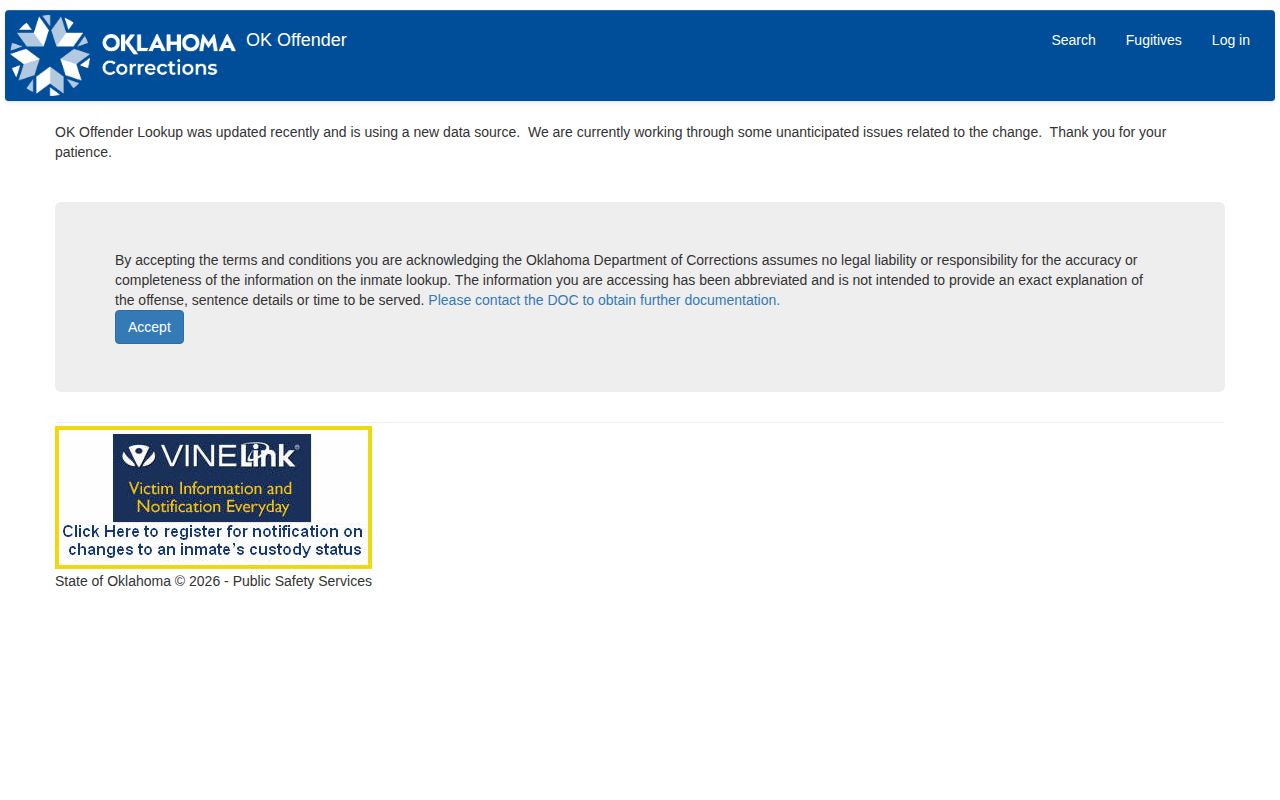
The result must be read with its own status, offense history, and retrieval date because the portal warns that its data are abbreviated.
Note: A name missing from the county roster proves neither release nor transfer; ask for the date and manner of discharge.
ODOC Choctaw County Release Estimates
The Oklahoma Pardon and Parole Board glossary defines PRD as ODOC's estimated release date for an offender. ODOC policy also refers users to Offender Lookup for offense, projected-release, and photo information. That terminology confirms the field's purpose, but it does not erase the agency's disclosure limit.
The official ODOC offender information page says an exact future release date is confidential unless the requester has a legitimate need. The inmate receives days remaining each month and may seek help from a records officer or case manager. Any calculated date is tentative because credit level, misconduct, and achievement credits can change it. Public copy should therefore quote only a label actually visible in a live record and route exact questions to ODOC.
ODOC also cautions that its lookup is an abbreviated account, not an exact explanation of the offense, sentence, or time to serve. A migration notice has warned of possible issues with the underlying data source. The lookup is an official status lead. A certified judgment and the agency's sentence-administration record are stronger when the calculation itself is disputed.
Oklahoma Credits Change Release Dates
Oklahoma's main earned-credit rule is 57 O.S. §138. One earned credit equals one day. Under the current research, Class 1 earns none per month and Class 2 earns 22. For a person ever convicted or adjudicated for a felony listed in subsection E, Classes 3 and 4 earn 33 and 44 per month. For a person without such a subsection-E felony, those levels earn 45 and 60. Class 3 generally requires at least three months and an excellent evaluation; Class 4 generally requires at least eight months and an outstanding evaluation.
Those figures are inputs to official sentence administration, not a safe home calculator. Credit classification can change. Misconduct or nonperformance may cause loss, and §138(C) permits restoration in qualifying cases through the required process. Achievement credits and corrections to time served may also affect the estimate. Consecutive sentences, meaning terms served one after another, add another layer that cannot be resolved from one public date field.
- Earned credit
- A day applied under statute and ODOC rules toward time administered.
- Achievement credit
- Credit tied to qualifying programs or accomplishments under corrections policy.
- Concurrent sentences
- Sentences that run at the same time as ordered.
- Consecutive sentences
- Sentences that run in sequence rather than together.
Note: No Choctaw County-specific jail good-time schedule was found, so ODOC credit levels should not be assigned to a local jail sentence.
Choctaw County Eighty-Five Percent Cases
The phrase “85 percent rule” applies to listed serious offenses, not every Oklahoma sentence. Under 21 O.S. §13.1, a person serving a qualifying sentence must serve at least 85 percent of imprisonment before parole consideration, and credits do not reduce that minimum in the usual way. The offense, offense date, and version of the law matter. A broad violent or nonviolent label is not enough.
Parole rules bring a second date problem. The Board's summary refers broadly to one-third for nonviolent cases, while 57 O.S. §332.7 contains offense-date rules. Many offenses committed from July 1998 through October 2018 use one-third, while many committed on or after November 2018 use one-fourth. Exclusions apply, including specified violent crimes, §13.1 offenses, and life without parole. The current statutory text controls.
Even correct eligibility does not predict release. A Board decision may be a grant, denial, pass, or recommendation. Some favorable recommendations still require gubernatorial action. ODOC then completes release processing and checks outstanding holds. The official parole overview should be paired with statutes and the person's own judgment.
Why Choctaw County Dates Move
A projected date can move forward or back without proving that the earlier estimate was false. It reflects the inputs available at that point. A court amendment, a corrected credit calculation, or a new hold can lawfully change what happens next.
| Change | Possible effect | Record to check |
|---|---|---|
| Corrected jail credit | Changes time already counted | Judgment and sentence computation |
| Credit loss or restoration | Moves the ODOC estimate | Sentence-administration record |
| Parole action | Creates or delays a conditional release path | PPB result and ODOC event |
| Detainer or warrant | May cause transfer or continued custody | Holding and receiving agency records |
| Amended judgment | Changes the legal sentence inputs | Signed court order |
| Administrative correction | Fixes data or calculation error | Agency correction record |
A detainer is another agency's request to hold or notify before release. Choctaw County may end its own booking and transfer the person to ODOC, another county, tribal authority, USMS, or ICE. That is a departure from the local jail, but not community release. Ask for the receiving authority whenever a predicted date arrives but the person does not return home.
Choctaw County Jail Date Requests
The Sheriff's official Records Division page provides in-person access Monday through Friday from 8 a.m. to 4 p.m. at 305 E. Jefferson St. in Hugo. It does not publish an operative request form or a full fee schedule. The page contains placeholder form wording, so do not download a form from an unofficial source. Call 580-326-2000 before a visit and ask for the accepted method and an estimate.
Request the booking-and-release record for the named person and booking number. Ask for the booking date and time, court or case number, sentence or release authority, release date and time, disposition code, and transfer destination if public. For a local sentence estimate, ask which judgment and jail-credit entry controls. The jail is not required to create a new calculation that it does not keep.
The Oklahoma Open Records Act provides prompt and reasonable access, not a fixed response deadline. Narrow requests are easier to identify and reduce name mistakes. If the answer depends on a court order, obtain that instrument from the Choctaw County court record as well.
Confirm Choctaw County Actual Release
Once the expected day arrives, check the custodian again. A current roster entry means the county still displays the person in custody. A removed entry is only a lead because the county's expired-booking message says the person may have been transferred or released and gives no time, manner, or destination. Ask for one affirmative event.
A jail register can show the historical date and manner of discharge. ODOC history can show state status and supervision. A court minute can order release, but the custodian supplies the actual departure timestamp. VINELink may send a prompt alert, though automated notices are not certified records. For alert setup, use the Choctaw County VINELink inmate search. Keep each system within its scope, especially when an outside hold may have produced a transfer.
Record the date on which each source was checked. If ODOC, the jail, and the docket disagree, ask the agency that controls the sentence calculation to explain its own entry. Do not average the dates or select the earliest one. A corrected official calculation and a later historical release event resolve different parts of the timeline.